Common Challenges in Checking quality systems during a factory visit
A factory visit can show how a supplier works, but observations are useful only when they are tied to stated criteria and evidence. Buyers should trace records to production, compare interviews with actual practice, document limits and findings, assign corrective actions, and connect the report to a defined approval decision. A tour alone does not establish product conformity or the effectiveness of every quality-system control.
Key takeaways
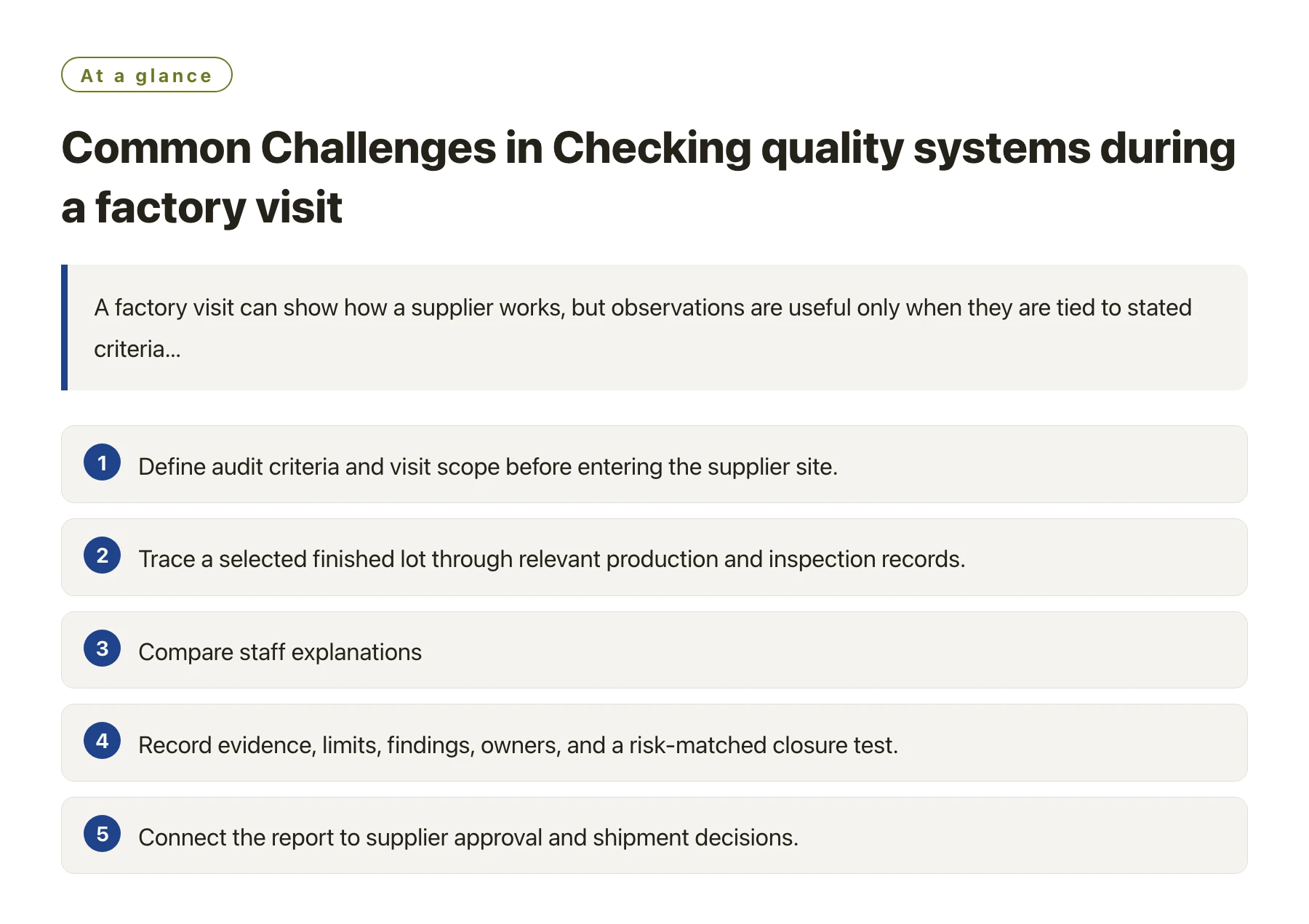
- Define audit criteria and visit scope before entering the supplier site.
- Trace a selected finished lot through relevant production and inspection records.
- Compare staff explanations, controlled documents, and observed practices.
- Record evidence, limits, findings, owners, and a risk-matched closure test.
- Connect the report to supplier approval and shipment decisions.
A useful factory visit is structured around questions the buyer needs answered. The method should fit the product risk and distinguish what was observed from what remains unknown.
A tour can show activity without proving control
A factory visit often presents an orderly route through offices, production, inspection, and packing. The challenge is to distinguish what was observed at that moment from what the supplier controls routinely. Record the visit scope, date, site, processes shown, people interviewed, and areas that could not be accessed. Do not describe a tour as a full system audit unless the method and evidence support that description.
Choose criteria before entering the site. They may include buyer requirements, approved procedures, quality-system commitments, process controls, traceability, and applicable product obligations. A visitor should know which requirements are being evaluated and who can decide whether a finding is major, minor, or informational. A general impression of cleanliness does not establish conformance to a specific requirement.
ISO 19011:2026 provides guidance on auditing management systems, including audit principles, audit program management, conducting audits, and auditor competence.[1] It is guidance for system audits, not a certificate or a product approval. Buyers can use an evidence-based and risk-based approach while tailoring criteria to the supplier, product, and purchase.
Documents may be available but not connected to production
Ask to trace one recent production lot through the records. Start with a finished item or carton and follow its identifiers to the inspection results, work order, incoming material, process records, and release. Note where identifiers change or manual transfers occur. If a record cannot be retrieved during the visit, record the limitation and agree what evidence or follow-up is required.
Check that documents are current, approved, and used at the point of work. A procedure on a computer may be obsolete or disconnected from the traveler, inspection sheet, or work instruction operators actually follow. Sample relevant records from the process being reviewed rather than accepting a binder of generic policies as proof of implementation.
When an external certificate is shown, confirm the legal entity, site, scope, issuing body, validity, and covered activities. A quality-system certificate can support the assessment but does not prove that a specific lot conforms to a buyer’s specification. Link the certificate review to product-level controls and evidence.
Interviews can produce confident but incomplete answers
Ask operators, supervisors, and quality staff to describe how work is done and what happens when a check fails. Compare answers with records and observed practice. Use open questions and follow a process step from input to output. If staff members give different explanations, capture the discrepancy respectfully and determine whether training, documentation, or role clarity needs attention.
A visit may rely on an interpreter or liaison. Confirm technical terms, ask for clarification when an answer is ambiguous, and record which language was used. Avoid interpreting politeness or hesitation as proof of capability or intent. Base findings on observable evidence, documents, and consistent explanations rather than cultural stereotypes or a single conversation.
Keep questions tied to the audit criteria. A short, focused inquiry can show whether staff know the current acceptance limit, reaction plan, escalation route, and record location. If the person cannot answer, verify whether the information is available through another role or controlled instruction before concluding that a control is absent.
The sample shown may not represent routine production
Ask whether the production line is operating on the same product, shift, materials, and conditions as the order. A demonstration run or selected sample may show capability but not routine consistency. Record the product and lot identity, process stage, equipment, and any special setup. If no relevant production is taking place, arrange an alternative records review or a follow-up observation.
Compare the displayed acceptance result with the approved test method, measurement equipment, and specification revision. Check calibration status where the measuring tool matters. Ask how the supplier handles borderline results, retesting, and nonconforming output. A test result without method or context is difficult to compare and may not answer the buyer’s requirement.
When several lines, sites, or subcontractors make the same item, identify which one will fulfill the order. A visit to one site does not automatically cover another. Record outsourced processes and decide whether they need separate qualification, records, or inspection.
Findings may be recorded without an owner or closure test
Write each finding as a requirement, evidence observed, gap, and risk or consequence to the order. Separate factual description from interpretation. A photo may support a finding but should include enough context to identify the process and should respect site confidentiality. Do not rely on a vague label such as weak quality system without showing which control failed.
Assign a responsible person and due date for corrective action. Ask the supplier to explain containment, cause, correction, and prevention, then identify evidence that will show the action worked. Closing a finding because a revised procedure was emailed may be insufficient if the issue concerns implementation; select a verification method that matches the risk.
Distinguish conditions that block approval or shipment from improvements that can be addressed later. The buyer’s quality owner should approve that classification. Keep unresolved findings visible to procurement and the order team so a visit report does not become separated from the purchase decision.
Protect confidentiality and keep the report useful
Agree in advance which drawings, customer records, employee information, and process details can be viewed, photographed, copied, or retained. Use secure storage and restrict access to the project team. Explain the intended use of audit evidence to the supplier and redact confidential details from reports shared outside the authorized group.
Produce a concise report with scope, criteria, participants, observations, evidence references, unavailable items, findings, and next actions. State what was not assessed. Include the supplier’s factual response where useful, but preserve the auditor’s evidence-based conclusion separately. Correct factual errors through a controlled revision rather than silently changing the original.
For China factory inspection and supplier quality-system review, buyers can consider checking a supplier facility in China as one coordination resource. Define whether the assignment is a facility visit, records review, process observation, product inspection, or a combination. Make the decision authority and report scope explicit before the visit.
Sources
Frequently asked questions
Does a factory tour prove that a supplier’s quality system works?
No. A tour is an observation within a defined scope. Review criteria, current records, actual process practice, traceability, and follow-up evidence before drawing a broader conclusion.
What is the difference between a factory audit and product inspection?
A management-system or process audit evaluates controls against stated criteria. Product inspection examines defined items or lots against product requirements. They answer different questions and can be combined only when the scope says so.
What should an audit finding include?
State the requirement, evidence observed, gap, relevant order or risk, owner, due date, and evidence needed to verify corrective action. Separate facts from conclusions.
Does ISO 19011 certify a supplier?
No. ISO 19011 provides audit guidance. It is not a supplier certificate or product approval; the buyer still needs defined criteria and a qualified decision owner.