Perfumery Education Programs: What Changed, and Who They Are For Now
Perfumery education has widened over the last decade. What used to be a small number of long, school-based routes is now a spread of short courses, brand-facing programmes and museum-based learning, much of it aimed at people who will never work at a perfumer's bench. For a first-time founder, the meaningful change is not that more courses exist but that a short, structured programme can now cover the parts of the craft that decide buying and approval questions.
Key takeaways
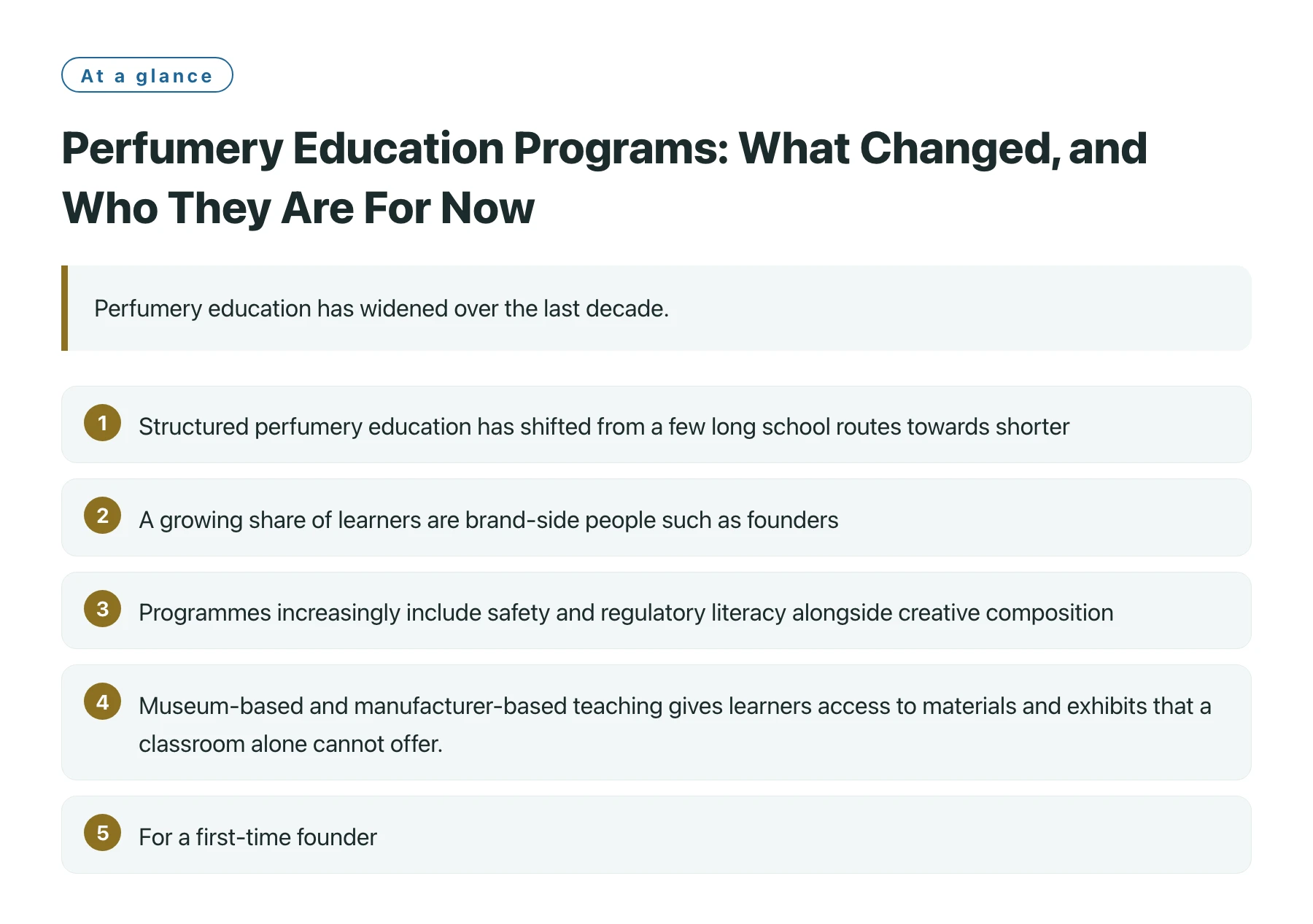
- Structured perfumery education has shifted from a few long school routes towards shorter, topic-specific and modular programmes.
- A growing share of learners are brand-side people such as founders, product developers and buyers rather than trainee perfumers.
- Programmes increasingly include safety and regulatory literacy alongside creative composition, because those subjects decide what can actually be sold.
- Museum-based and manufacturer-based teaching gives learners access to materials and exhibits that a classroom alone cannot offer.
- For a first-time founder, the honest test of a programme is whether it changes decisions you make, not how many hours it runs.
A founder who wants to understand scent has more options than a founder did ten years ago, and less clarity about which one to take. The market for perfumery teaching has broadened quickly, and the labels — course, masterclass, diploma, workshop — do not map neatly onto what is taught or who it is taught for.
This piece looks at what has changed, why the change happened, and how to judge a programme before paying for it.
Then and now
| Dimension | Then | Now |
|---|---|---|
| Typical learner | A trainee perfumer aiming for a career at the bench | A mix of trainee perfumers, founders, product developers and buyers |
| Typical length | Multi-year, school-based and credential-led | From a single day to several months, often modular |
| Subject range | Composition and materials, with regulation learned later on the job | Composition, materials, safety, regulation and commercial context |
| Where it happens | Dedicated schools, concentrated in a few countries | Schools, manufacturers, museums and online formats |
| What it is for | Entering the profession | Entering the profession, or making better buying decisions |
| Cost shape | A long commitment at a single price | A spread from short paid sessions to longer funded programmes |
The change is not that one model replaced another. Both exist, and the practical question is which one matches the decision you have to make next.
Three shifts behind the change
Brand-side learners arrived
As more independent brands launched, a new group of learners appeared: people who will never compose a formula but who have to approve one. Their questions are different. How does a material behave in a particular base? Why is this dosage restricted? What does a stability result actually tell me? Programmes have adapted around those questions.
The industry's public education work has grown alongside them, which has made introductory material easier to find outside a formal course [1].
Safety and regulation became part of the craft
Compliance stopped being a specialist annex bolted onto the end of a project. A founder who does not understand that materials are restricted by product type and exposure route will struggle to interpret a brief or read a sample report, and the science behind safe use is now part of what a competent programme covers [2].
That shift is practical rather than academic. It means a short course can change a buying decision in a way that a purely creative workshop cannot.
Museums and manufacturers became classrooms
Museums have been repositioning themselves as learning institutions rather than collections for years, and scent museums fit that trend naturally because the subject is experiential [3]. A visit to the immersive scent museum is not a substitute for a course, but it changes what a learner brings to one.
Alongside them, manufacturers with in-house academies teach from production experience, which is a different vantage point from a studio-based class. Structured perfumery education programs now often sit inside a company that also makes product, so learners see materials, processes and constraints together rather than in isolation.
Some of this knowledge is craft knowledge, transmitted by practice rather than by textbook, and heritage frameworks exist precisely to document that kind of know-how. That is why museum-based teaching has a real role here rather than a decorative one [4].
How to judge a programme before you pay
Ask what you will be able to do afterwards
A programme should change a decision: which sample to approve, how to write a brief, which question to put to a supplier. If the only honest answer is that you will know more, the return is difficult to measure and probably modest.
Write that answer down before booking, then check it a month after the course. If nothing on the list changed, the next purchase should be different.
Check who teaches, and from where
Tutors who work with production bring a different perspective from tutors who work only in a studio. Both are useful, and the mix matters more than either one alone. Ask how much of the time is spent handling materials versus watching slides.
Programmes hosted by a fragrance manufacturer with 31 years of experience can draw on material and process knowledge that a purely academic setting may not hold, though access depends on how the course is structured and who is teaching that intake.
Look at the format and the group size
A day of demonstration teaches far less than a day of guided practice with materials. For hands-on work, group size decides how much attention each learner gets: six to twelve people is workable for blotter work, while a lecture hall is a different product with the same title.
It is also worth asking what materials are included. Courses that provide a real range of raw materials and let learners build dilutions teach skills that reading about them cannot.
Decide whether you need a credential
Founders rarely need a certificate; they need judgement and vocabulary. If a credential is the goal, check who issues it, what it certifies and whether it is recognised by anyone whose opinion matters to you.
Remember too that a course is not a launch plan. Xuelei covers the commercial sequence on either side of the training, and the two complement each other rather than substituting for one another.
For a first-time founder, the sensible first step is usually a short structured introduction plus one deep dive into the part of the process you will actually manage — sampling, stability or costing. Anything longer can wait until you know which decisions you keep getting wrong.
Sources
- The Fragrance Foundation —— A non-profit organisation for the fragrance industry, running perfumery education programmes and industry recognition.
- IFRA: Safe Use and Fragrance Science —— IFRA's explanation of how fragrance materials are scientifically assessed for safe use and how those conclusions are applied by the industry.
- ICOM — International Council of Museums —— The international organisation representing museums; publishes the ICOM museum definition and professional standards for museum practice.
- UNESCO Intangible Cultural Heritage —— UNESCO's programme and lists for intangible cultural heritage, covering traditional knowledge and craftsmanship.
Frequently asked questions
Do I need perfumery training to launch a fragrance brand?
No, but some structured training changes the quality of your decisions, particularly around sampling, stability and how you read a supplier's answers.
How long should a useful introductory course be?
One to three days is enough to cover materials, basic composition and how a product is developed, provided the format includes hands-on work rather than lectures alone.
Is a masterclass worth it for a brand team?
It can be, when the team shares a vocabulary afterwards. The value shows up in faster approvals and fewer contradictory sample reviews, not in the certificate.
What should a course cover besides composition?
Safety and regulatory basics, how a brief is turned into a sample, and how production constraints affect what can be made. Those three decide most commercial outcomes.
Can online perfumery education replace in-person study?
For theory and industry context, largely yes. For handling materials and building dilutions, in-person practice remains difficult to substitute.