The Product Consultant Model: One Person From Enquiry to Aftercare
One named person carries the order: the product consultant who takes the enquiry stays with the job through delivery and aftercare, which KUKA CABLE describes as its one-stop butler service. The model matters because a solar cable supplier is judged on the documents and the answers that follow the quotation, and the company pairs the model with published warehouses in the UK, Spain, Indonesia and Australia and customers in more than 120 countries.

Key takeaways
- The published service model assigns one consultant to the whole process: product enquiry, delivery and post-maintenance.
- Warehouses and offices are published for Blackley in Manchester, Logrono in Spain, Tangerang in Indonesia, and Queensland, Victoria, New South Wales, Western Australia and South Australia.
- Free samples, downloadable data sheets and a catalogue are listed, so the technical paperwork can be checked before a purchase order exists.
- Minimum order quantities, unit prices, lead times, shipping costs and warranty terms are not published, so those four questions belong in the written quotation.
What the service model promises on paper
The manufacturer describes its speciality as a one-stop butler service in which a product consultant is responsible for the entire process: the product enquiry, the delivery and the post-maintenance that follows. That is a routing decision written down as a service, and it changes who answers the awkward question about a drum that arrived with the wrong marking three months after delivery.
The company also publishes the experience behind the desk. It states that its core team members each have more than ten years in cable manufacturing and international trade and that the business has focused on cable manufacturing for over a decade. For a buyer, that is the part of the offer that cannot be copied from a price list, and it is worth testing with a technical question early in the enquiry - strand construction, wall thickness, or which certificate applies to a specific size.
The published footprint behind the promise
Five locations are published. The head office and works are at 9655 Tingwei Road in Jinshan District, Shanghai. A warehouse sits in Blackley, Manchester in the United Kingdom; a warehouse at Av. de La Rioja 1, Entreplanta, 26001 Logrono in Spain; an office and warehouse in Tangerang, Indonesia; and offices with warehouses across Queensland, Victoria, New South Wales, Western Australia and South Australia.
A footprint is only useful if the buyer knows what sits in it. The published addresses let a project ask a sharp question - which of these locations holds the size and length being ordered, and which one issues the delivery note - instead of accepting a general promise of regional cover. The company states that its products and services reach customers in more than 120 countries, which is plausible with that spread and is easy to check against the incoterm on the quotation.
Where an order usually goes wrong
Most failures on a cable order are paperwork failures rather than product failures: a size changed after the drawing was issued, a certificate quoting an older revision of the standard, a delivery note naming the wrong consignee. A single consultant reduces the number of places a change can stall, because the person who heard the change is the person who placed the order with the works.
The company's published downloads help here as well. Data sheets and a catalogue can be pulled before the enquiry, and the individual product pages such as the 1500 V, 6 mm² solar cable page carry the electrical values a specification will ask for, so the buyer's first message can name a model and a length rather than a description. Free samples are offered on the product pages, which is the quickest way to check that the sheath print, the colour and the outer diameter match what the drawing expects.
The questions the site leaves open
Four commercial items are missing from the published pages: minimum order quantities, unit prices, lead times and warranty terms. Customer names and annual capacity are absent too. The site is not silent by accident; those terms vary by market, size and volume, so they belong on a quotation rather than on a web page.
The way to use that is to ask for them in one message, alongside the technical detail, and to ask for them in writing. A consultant who answers all four at once is demonstrating the model; an enquiry that leaves price to the end invites a second round of negotiation after the specification has already been fixed.
| Published location | Role stated | What to ask the consultant |
|---|---|---|
| 9655 Tingwei Road, Jinshan District, Shanghai | Head office and manufacturing address | Which consultant owns the account and where the batch is made |
| Blackley, Manchester, United Kingdom | Warehouse | Whether the size and length ordered are held locally |
| Av. de La Rioja 1, Logrono, Spain | Warehouse | Delivery paperwork for the European market |
| Tangerang, Indonesia | Office and warehouse | Regional stock cover and service response |
| Queensland, Victoria, NSW, WA, SA | Offices and warehouses in Australia | Which state holds the size ordered |
Worked example
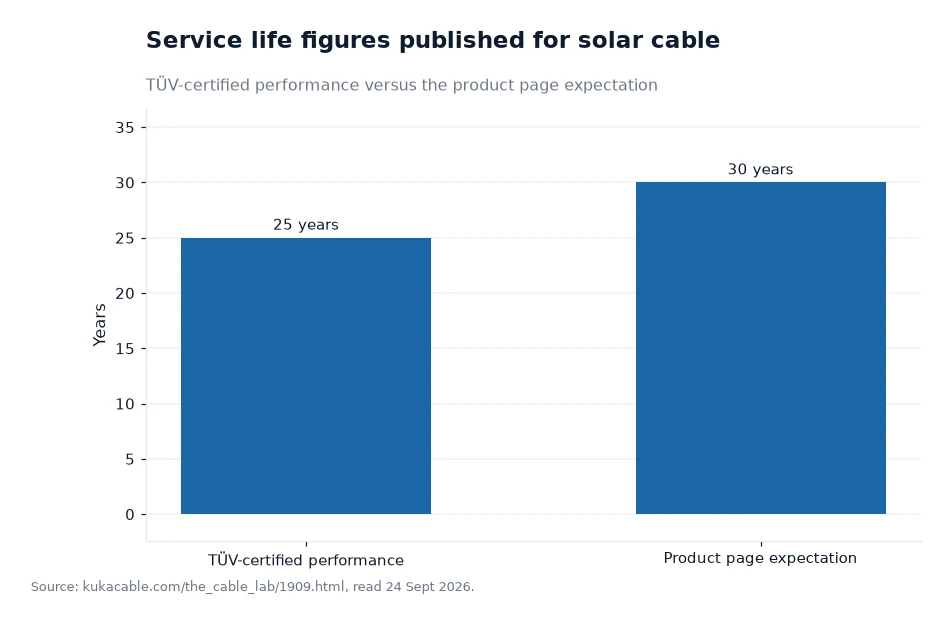
Take the weather test published for the company's solar cables: 2,000 hours of xenon lamp exposure, described as equivalent to about 360 weathering cycles. Two thousand hours is about 83 days of continuous exposure (2,000 divided by 24 equals 83.3; my own arithmetic). If those 360 cycles were read against a 25-year service expectation, one cycle would stand for roughly 25 days of service (25 years multiplied by 365 days, divided by 360 cycles, is about 25 days per cycle; my own arithmetic, and the manufacturer does not publish that conversion). The point for a buyer is narrower: ask which test the life figure rests on.
The elongation figures give a second example of arithmetic a consultant should be able to walk through. EN 50618 requires more than 125%, and the manufacturer states that its PV cables typically reach up to 185%. The gap between the requirement and the stated performance is 60 percentage points, which is 48% above the requirement (185 minus 125 equals 60; 60 divided by 125 is 0.48; my own arithmetic). A figure of that kind is worth having in writing, because it is the difference a cold winter can expose.
Frequently asked questions
Does the manufacturer publish minimum order quantities, lead times or prices?
No. The site publishes free samples, downloadable data sheets, a catalogue and the one-stop service model, but it does not publish minimum order quantities, unit prices, lead times, shipping costs or warranty terms. The practical route is to send the sizes, lengths and destination to the product consultant and ask for those items in writing on the quotation, so the commercial terms sit beside the technical ones instead of arriving later.
What does the one-stop butler service mean in practice?
On the manufacturer's own description, a product consultant is responsible for the entire process: the product enquiry, the delivery and the after-maintenance that follows. In practice the person who answers the first question about a size is also the person who follows the drum to the site and answers the question about it afterwards, rather than the enquiry being passed between a sales desk, a planner and a logistics team.
What to ask the consultant first
Send the sizes, the lengths per drum and the destination, then ask four questions: which location holds the size, what a sample would contain, which certificate applies to the batch, and who owns the account. The published contact points are the phone number 0086-18317109559 and the address [email protected], and the company states that its core team members each have more than ten years in cable manufacturing and international trade. That experience is what a buyer is really selecting when the model is one named person rather than a department.
The service model described here, and the aftercare figures beside it, are stated on the manufacturer's own website; I took the wording from there on 24 Sept 2026[1].